
How to Clean Solar Panels Safely
What you can clean yourself without risking the panels or the roof, the products that damage glass, and when to call someone.
How to clean solar panels safely is mostly about the roof and the water pressure — the cleaning itself is the easy part. Cleaning solar panels is not difficult — the risk is not the cleaning, it is the roof, the pressure and the products. Get those right on a single-storey roof and you can do it yourself. Get them wrong and you can crack glass, void a warranty or fall.
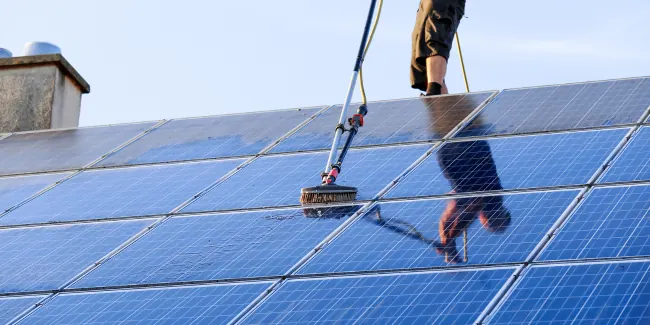
The safe method
- Work early morning or late afternoon — the glass is cooler, so water does not evaporate before you have rinsed it off.
- Never walk on the panels. They are glass over a frame, and micro-cracks are invisible until a panel fails.
- Use a soft brush on a pole from the edge where you can, or a soft broom head if you are on the roof.
- Rinse with low-pressure water — a garden hose, not a pressure washer.
- Work top to bottom, so dirty water does not run back over what you have cleaned.
- Do not use a squeegee with a metal edge, and never an abrasive pad or steel wool.
What damages panels
- A pressure washer — it can drive water past the frame seals and crack cells through thermal shock on a hot day.
- Detergents and dish soap — they leave a film that attracts more dust, and some leave residue that bakes on.
- Hard water — mains water dries and leaves mineral spotting, which is why professional cleans use a pure-water rinse.
- Walking on the glass — micro-cracks, hot spots and a warranty argument.
- Cold water on hot glass — thermal shock on a 40°C afternoon.
- Scrubbing at bird droppings — they are abrasive when dry; soften them first.
Roof safety is the real limit. Tile roofs crack, metal roofs are slippery when wet, and a fall from 3 metres is a serious injury. If the roof is steep, two-storey, or you are not confident on it, that is the point to stop — not the cleaning.
When it is worth calling someone
- Two-storey or steep roof.
- Bird droppings across the array — they need contact cleaning, and they usually mean a nest underneath.
- Hard water or visible mineral spotting.
- Lichen, moss or a film that will not rinse.
- A large array — 20+ panels is a long day on a hot roof.
- You want it inspected while someone is up there. Cracks, cable in water and lifted flashings are not things you will spot from the ground.
How often
Once or twice a year in Southeast Queensland, and after a dust storm or a bushfire smoke event. A professional clean also uses a pure-water rinse so nothing dries on the glass — the reason a DIY clean can look worse than before once it dries. See solar panel cleaning.
Common questions
Can I clean solar panels myself?
On a single-storey roof with safe access, a soft brush and a low-pressure hose is reasonable. What goes wrong is high pressure near the frames and cabling, abrasives, hard water drying on the glass, or walking on the panels.
Do solar panels need cleaning, or does rain do it?
Rain rinses loose dust and leaves the film, the droppings and the mineral residue as it dries. Tilted glass sheds water before it can lift the dirt, which is why an array can look streaked after a storm and still be shaded.
How often should solar panels be cleaned?
Once or twice a year for most Southeast Queensland roofs. More often near main roads, under trees, on a farm, or after a dust storm or bushfire smoke event.
Do solar panels need cleaning, or does rain do it?
Rain rinses loose dust and leaves the film, the droppings and the mineral residue as it dries. Tilted glass sheds water before it can lift the dirt, which is why an array can look streaked after a storm and still be shaded.
Book a clean and inspection: 0422 778 277 or contact us.
Get your aircon or solar panels cleaned
Send us your suburb and what needs cleaning and we will come back with a quote — no call-out surprises.